Intraparietal Sulcus
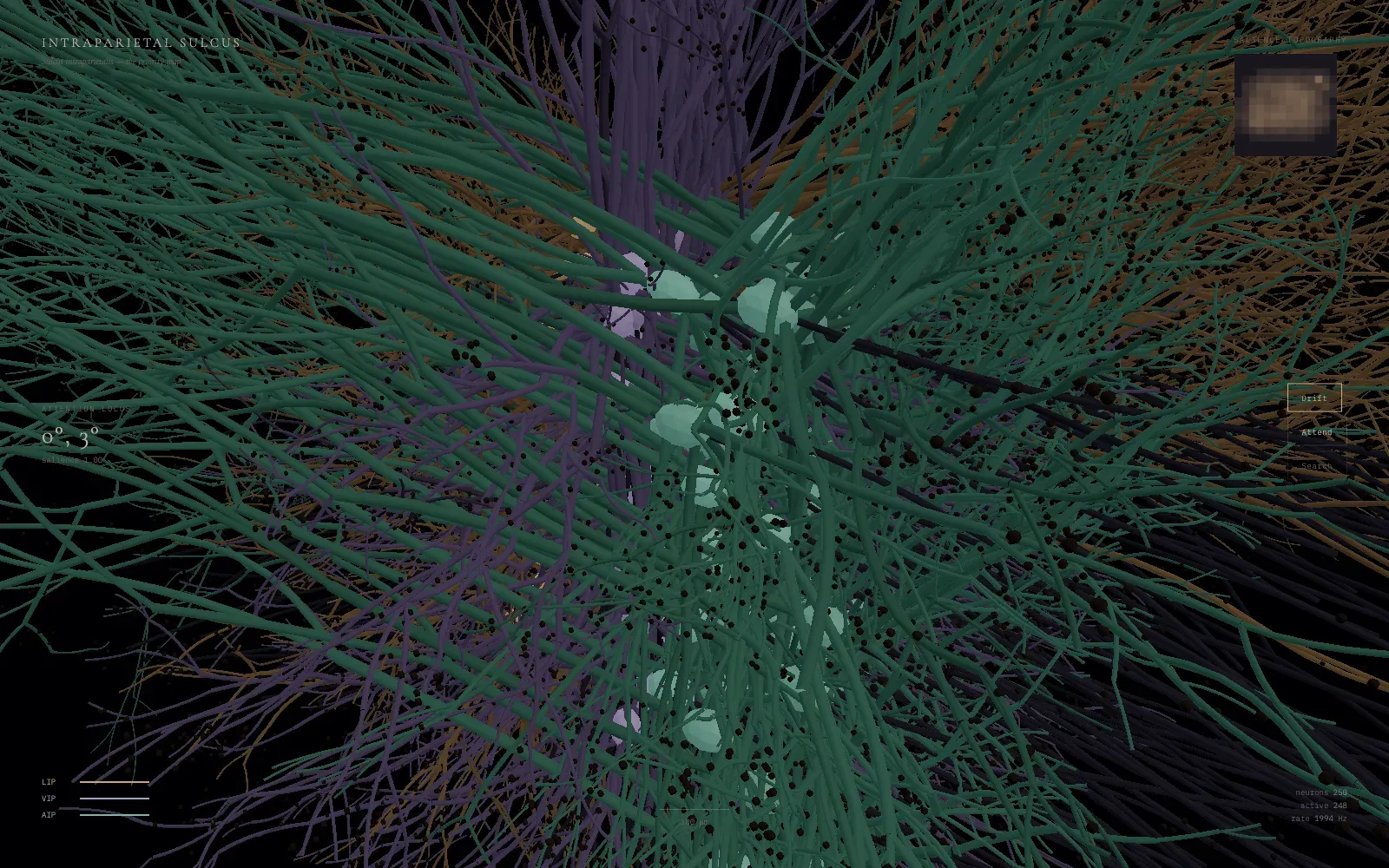
A priority-map model of the intraparietal sulcus: 250 pyramidal cells on three banks, and a 14 by 14 salience grid that settles on one locus.
The idea
The page calls the intraparietal sulcus a priority map: a topographic sheet of salience, relevance and intention. Pyramidal cells tile a visual field. Where their receptive fields overlap, nearby cells excite one another and distant cells inhibit, and the sheet settles on a single peak.
That peak is the attention locus. The controls move the input. The readout tells you where the competition landed.
The approach
The fold is three banks. One hundred tan cells sit on the lateral bank, labelled LIP. Seventy lilac cells sit in the fundus, labelled VIP. Eighty teal cells sit on the medial bank, labelled AIP. Each soma carries an apical tree, three to five basal dendrites, and a dark grey axon. A scale under the fold reads 100 μm. Drift starts on, and it only moves the camera through the banks.
Top right, SALIENCE TOPOGRAPHY is a 120 pixel square drawn as a 14 by 14 grid. Quiet map points stay dark brown. Activity brightens a cell towards the tan of the LIP somata. In Search, the stronger target is a tan ring and the others are thin white rings.
On the left, ATTENTION LOCUS prints the peak receptive-field centre as a pair of degrees, each coordinate multiplied by 12, or a dash when the peak activity is at or below 0.12. Under it, salience is that peak to two decimals. The three bars at bottom left, tan, lilac and teal, grow with the mean activity of LIP, VIP and AIP. Bottom right counts neurons, cells above activity 0.2, and a rate in hertz.
Attend drops an input of strength 2.5 on a random map point. Search plants five, six or seven targets on a ring and drives the first of them at 2.2, the rest at 0.7. Clicking the topography attends at that point, at the same strength as Attend. A cell links, with probability 0.1, to others within a distance of 18. When it fires, a linked cell whose receptive field is within 0.2 is excited, and one further away is inhibited.
- 100 tan LIP cells on the lateral bank, 70 lilac VIP cells in the fundus, 80 teal AIP cells on the medial bank
- SALIENCE TOPOGRAPHY is a 14 by 14 grid; the stronger search target is a tan ring
- ATTENTION LOCUS prints degrees, each map coordinate times 12
- Search plants 5, 6 or 7 targets; the marked target is driven at strength 2.2
Play the current build: /simulations/intraparietal-sulcus .